Mars Sample Return: NASA’s 2026 Mission Plan
Advertisers
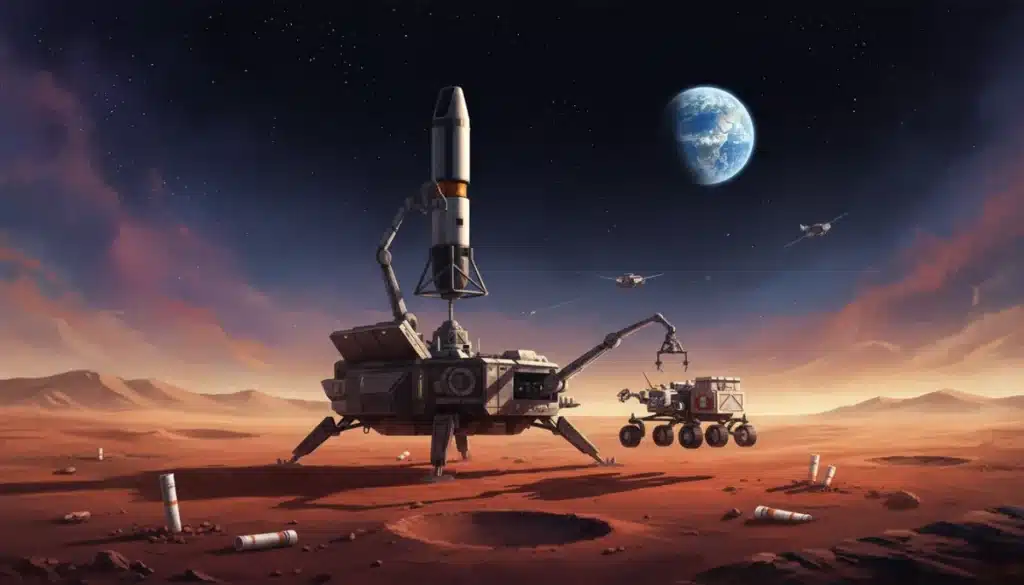
NASA is targeting an early 2026 launch for its Mars Sample Return Mission, a groundbreaking effort to retrieve Martian geological samples collected by the Perseverance rover.
Advertisers
The ambitious endeavor of Mars Sample Return Mission represents a monumental leap in space exploration, with NASA setting an early 2026 target for its launch. This mission aims to bring precious Martian samples back to Earth for in-depth scientific analysis, promising to revolutionize our understanding of the Red Planet’s history and potential for life.
The ambitious goal of Mars Sample Return
NASA’s Mars Sample Return mission is arguably one of the most complex and critical undertakings in robotic space exploration. It is not merely about landing on Mars, but about a multi-stage process to collect, secure, launch, and transport invaluable Martian samples safely back to Earth. This endeavor involves an unprecedented level of international collaboration, primarily with the European Space Agency (ESA), pooling resources and expertise to overcome the immense technical challenges.
Advertisers
The primary scientific motivation behind this mission is profound. By bringing pristine Martian samples to Earth, scientists can use the most sophisticated laboratories and instruments available, which cannot be miniaturized and sent to Mars. This will allow for analyses far beyond what current or future rover-based instruments could achieve, potentially revealing definitive evidence of past life on Mars or insights into the planet’s geological and climatic evolution.
Why bring samples back?
- Advanced analysis: Earth-based laboratories offer a wider array of analytical tools, higher precision, and greater flexibility than instruments sent to Mars.
- Long-term study: Samples can be studied by multiple generations of scientists, using new techniques as they emerge.
- Contamination control: Strict protocols ensure samples remain pristine, minimizing terrestrial contamination.
- Comparative planetology: Direct comparison with Earth and lunar samples provides crucial context for planetary formation.
The mission’s scope extends beyond just scientific discovery; it also serves as a critical testbed for technologies and operational procedures that will be essential for future human missions to Mars. The ability to launch from the Martian surface, rendezvous in Mars orbit, and execute an Earth return trajectory are all vital steps toward sending astronauts to the Red Planet.
In conclusion, the Mars Sample Return mission is a testament to human ingenuity and our unyielding quest for knowledge. It promises to unlock secrets about Mars that have remained elusive, paving the way for a new era of planetary science and potentially human exploration.
Perseverance’s critical role in sample collection
The foundational phase of the Mars Sample Return mission is already underway, spearheaded by NASA’s Perseverance rover. Since its landing in February 2021, Perseverance has been diligently exploring the Jezero Crater, a site believed to be a former lakebed and river delta, making it an ideal location to search for signs of ancient microbial life and collect diverse geological samples.
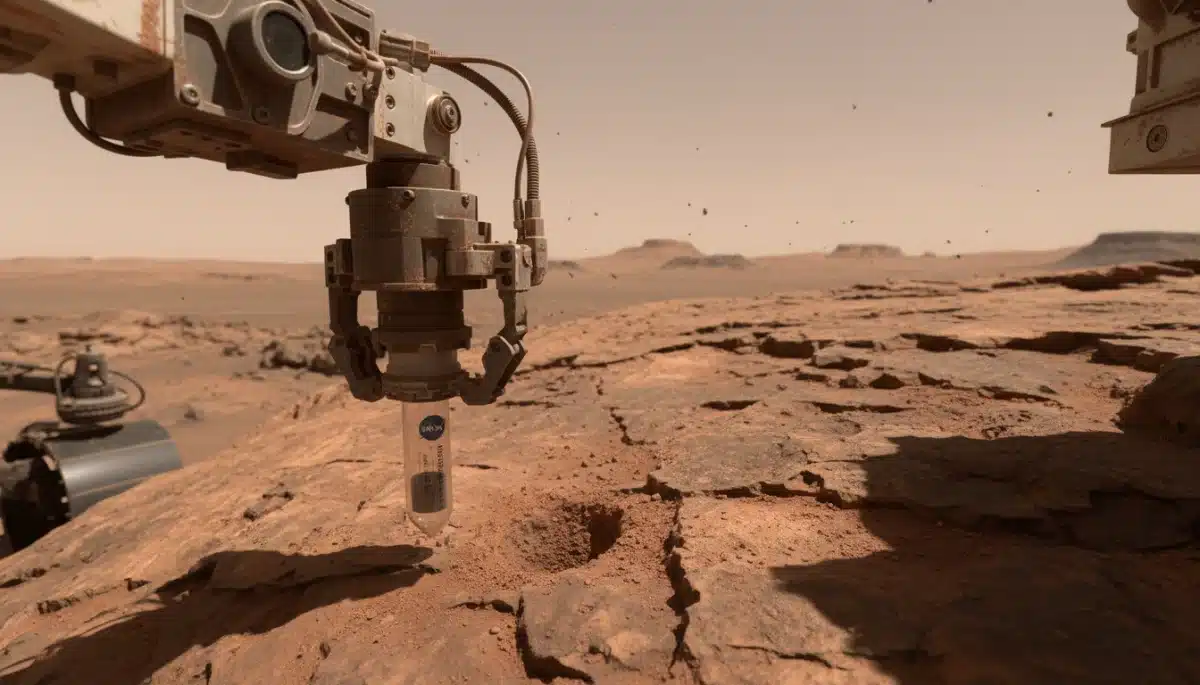
Perseverance is equipped with a sophisticated drilling system designed to extract core samples from Martian rocks and soil. These samples, each about the size of a piece of chalk, are hermetically sealed in ultra-clean titanium tubes. The rover then deposits these tubes at designated locations on the Martian surface, creating a ‘sample depot’ for future retrieval.
How Perseverance collects and stores samples
- Drilling mechanism: The rover uses a rotary percussive drill to extract core samples, minimizing damage to the sample integrity.
- Sample encapsulation: Each sample is sealed in a titanium tube, then photographed and stored inside the rover’s body.
- Depot creation: Tubes are strategically dropped on the Martian surface at locations that are flat and free of obstacles, ensuring easy access for the future retrieval mission.
- Data logging: Detailed records of each sample’s location and geological context are transmitted back to Earth, vital for scientific interpretation.
The selection of Jezero Crater was deliberate, based on extensive orbital data suggesting a rich geological history that could preserve biosignatures. The rover has already collected a variety of igneous, sedimentary, and regolith samples, offering a comprehensive cross-section of the Martian environment. The success of Perseverance in collecting and caching these samples is paramount, as these are the very specimens that the future return mission aims to retrieve.
The rover’s continued operations are crucial not only for collecting more samples but also for characterizing the geological context of the sample depot. This context will be invaluable for scientists on Earth when they finally get to analyze the samples, helping them understand the environmental conditions under which these rocks and soils formed.
In essence, Perseverance is the pioneering scout, laying the groundwork for the most ambitious robotic mission to date. Its successful sample collection and caching are indispensable steps towards bringing a piece of Mars to Earth.
Engineering challenges for the 2026 launch target
Meeting the early 2026 launch target for the Mars Sample Return mission presents a formidable array of engineering challenges. This multi-component mission requires precision, reliability, and innovative solutions across several distinct spacecraft and operational phases. Each element, from the Sample Retrieval Lander to the Mars Ascent Vehicle and the Earth Return Orbiter, must perform flawlessly.
One of the most critical components is the Sample Retrieval Lander (SRL). This large lander must safely deliver both a Sample Fetch Rover (SFR) and the Mars Ascent Vehicle (MAV) to the Martian surface. The SRL’s landing system will need to be robust enough to handle a heavier payload than previous Mars landers, requiring advanced guidance and navigation systems for a soft and accurate touchdown.
Key engineering hurdles
- Mars Ascent Vehicle (MAV): Designing a rocket capable of launching from the surface of Mars, surviving the harsh environment, and achieving orbit is an unprecedented feat.
- Orbital rendezvous: The Earth Return Orbiter (ERO) must precisely rendezvous with the MAV in Mars orbit to capture the sample container.
- Sample chain of custody: Ensuring the integrity and sterility of the samples throughout the entire journey, from Martian surface to Earth laboratory, is paramount.
- Planetary protection: Preventing the contamination of Mars by Earth organisms and, crucially, the contamination of Earth by potential Martian organisms.
The Sample Fetch Rover, while smaller than Perseverance, must be agile and autonomous enough to navigate to the sample depot, locate the tubes, and transfer them to the MAV. This requires sophisticated vision systems and robotic manipulation capabilities to handle the delicate sample tubes. The MAV itself is a marvel of engineering, a two-stage rocket designed to lift the sample container into Mars orbit, marking the first time a rocket will launch from another planet.
Furthermore, the Earth Return Orbiter, provided by ESA, is responsible for capturing the sample container in Mars orbit and transporting it back to Earth. This involves complex orbital mechanics, precise docking maneuvers, and a robust Earth entry system to ensure the safe delivery of the samples. The entire mission architecture is a symphony of interconnected systems, each pushing the boundaries of current space technology.
Overcoming these engineering challenges by the 2026 deadline requires intense collaboration between NASA, ESA, and numerous industrial partners. The successful execution of each stage will not only achieve a scientific breakthrough but also demonstrate the capabilities necessary for future human exploration beyond Earth.
The journey home: Earth Return Orbiter and re-entry
The most critical phase of the Mars Sample Return mission, following the successful launch from the Martian surface, is the journey of the samples back to Earth. This intricate process involves the Earth Return Orbiter (ERO), an advanced spacecraft designed to capture the sample container in Mars orbit and safely transport it across interplanetary space, culminating in a precise re-entry and landing on Earth.
After the Mars Ascent Vehicle (MAV) launches the sample container into Mars orbit, the ERO, already orbiting Mars, will perform a series of delicate maneuvers to rendezvous with and capture the basketball-sized container. This orbital ballet requires extreme precision, as the ERO must locate, track, and then grapple the uncrewed container, securing it within its protective containment system. This capture is one of the mission’s most technically demanding operations, akin to catching a bullet with another bullet in deep space.
Steps for the return journey
- Orbital capture: The ERO uses advanced navigation and robotic systems to rendezvous and capture the sample container from the MAV.
- Containment and sealing: Once captured, the sample container is hermetically sealed within a secondary containment system to prevent any potential biological contamination.
- Interplanetary cruise: The ERO then fires its engines to depart Mars orbit and embark on a several-month-long cruise back to Earth.
- Earth re-entry: Upon approaching Earth, the sample return capsule, containing the precious Martian samples, is released from the ERO for atmospheric re-entry.
Once the sample container is securely onboard the ERO and sealed within its planetary protection system, the orbiter will begin its long journey back to Earth. This interplanetary cruise phase will last for several months, with mission controllers meticulously monitoring the spacecraft’s trajectory and health.
The final act of the mission involves the release of the Earth Entry System (EES) from the ERO as it approaches Earth. The EES, a small, robust capsule containing the sealed Martian samples, will then undergo a high-speed atmospheric re-entry. This capsule is designed to withstand the extreme heat and forces of re-entry, deploying parachutes for a soft landing at a designated recovery site, likely in a remote desert location.
The entire sequence, from orbital capture to Earth landing, is meticulously planned and rehearsed to ensure the absolute safety and integrity of the Martian samples. The successful completion of this phase will mark a historic achievement, bringing extraterrestrial material from Mars to Earth for the first time.
Scientific promise: what samples could reveal
The scientific community eagerly anticipates the return of Martian samples, as they hold the potential to unlock profound secrets about the Red Planet’s past and future. These pristine geological specimens, collected from the Jezero Crater, could provide unprecedented insights into Mars’ ancient environment, its geological evolution, and, most excitingly, whether life ever existed beyond Earth.
One of the primary goals is to search for biosignatures, chemical or structural evidence of past microbial life. Unlike instruments on Mars, Earth-based laboratories can perform far more detailed and sensitive analyses, employing techniques like high-resolution microscopy, isotopic analysis, and organic chemistry to detect minute traces of organic compounds or microfossils that might indicate ancient life.
Potential scientific breakthroughs
- Evidence of ancient life: Direct examination for biosignatures in sedimentary rocks, potentially confirming past microbial existence.
- Martian geology and climate history: Detailed analysis of mineralogy, elemental composition, and rock textures to reconstruct Mars’ geological and climatic evolution.
- Water history: Understanding the history of liquid water on Mars through hydrous minerals and isotopic ratios.
- Planetary evolution: Insights into the formation and differentiation of Mars, providing context for the evolution of rocky planets.
Beyond the search for life, the samples will offer a wealth of information about Mars’ geological and climatic history. Scientists can precisely date the rocks, determine their mineralogical composition, and study isotopic ratios to understand when and how liquid water flowed on the surface, the nature of volcanic activity, and the evolution of the Martian atmosphere. This data will help piece together the planet’s story, from its formation billions of years ago to its current arid state.
The ability to study these samples in Earth-based laboratories means that scientists can utilize instruments that are too large or too sensitive to send to Mars. This includes electron microscopes, mass spectrometers, and X-ray diffraction machines, which can reveal details at the atomic and molecular level, providing a comprehensive understanding of the Martian material.
Furthermore, the samples will be preserved for future generations of scientists, allowing for new analyses as technology advances. This long-term accessibility ensures that the samples will continue to be a source of scientific discovery for decades, if not centuries, to come. The return of these samples represents a pivotal moment in our quest to understand our place in the universe and the potential for life beyond Earth.
International collaboration and future missions
The Mars Sample Return mission is not solely a NASA endeavor; it stands as a shining example of international collaboration, primarily involving the European Space Agency (ESA). This partnership underscores the immense complexity and cost of such an undertaking, demonstrating how pooling resources, expertise, and technological capabilities can make seemingly impossible missions achievable. The collaborative model set by this mission will undoubtedly influence future deep space exploration projects.
ESA’s significant contributions include the development of the Earth Return Orbiter (ERO) and the Sample Fetch Rover (SFR). The ERO is crucial for capturing the sample container in Mars orbit and bringing it back to Earth, while the SFR is designed to collect the sample tubes from the Martian surface. This division of labor not only optimizes resources but also leverages the unique strengths and experiences of both space agencies.
Benefits of international partnerships
- Shared expertise and resources: Combining the scientific and engineering talents of multiple nations.
- Cost efficiency: Distributing the substantial financial burden of complex missions.
- Enhanced capabilities: Access to a wider range of technologies and operational capabilities.
- Global scientific consensus: Fostering a broader understanding and acceptance of mission objectives and findings.
The success of the Mars Sample Return mission will have profound implications for future space exploration, particularly for human missions to Mars. The technologies developed and proven, such as launching from Mars and orbital rendezvous, are directly applicable to sending astronauts to the Red Planet and eventually bringing them back safely. This mission serves as a critical stepping stone, de-risking many aspects of human Mars exploration.
Beyond Mars, the collaborative framework established could pave the way for similar sample return missions from other celestial bodies, such as the moons of Jupiter or Saturn, or even asteroids. These missions could provide vital clues about the origins of our solar system and the potential for life in diverse environments.
Ultimately, the Mars Sample Return mission exemplifies a global commitment to scientific discovery and exploration. It highlights the power of international cooperation in pushing the boundaries of what is possible, setting a precedent for a future where humanity works together to unravel the mysteries of the universe.
Preparing for a new era of Martian discovery
As NASA targets an early 2026 launch for the Mars Sample Return Mission, the world stands on the cusp of a new era in Martian discovery. This mission is more than just a technological marvel; it represents a profound commitment to understanding our planetary neighbor in unprecedented detail. The preparations ongoing, from the detailed engineering designs to the rigorous scientific planning, are all geared towards ensuring the safe and successful return of Martian samples to Earth.
The scientific community is already laying the groundwork for the analysis of these samples. Laboratories across the globe are preparing specialized facilities to handle extraterrestrial materials, ensuring that the samples remain pristine and uncontaminated. Strict planetary protection protocols are being finalized to prevent any potential forward or backward contamination, safeguarding both Mars and Earth.
Key aspects of mission preparation
- Facility readiness: Preparing Earth-based laboratories with specialized clean rooms and analytical instruments for sample analysis.
- Planetary protection protocols: Establishing stringent guidelines to prevent biological contamination of Earth or Mars.
- Data integration: Developing systems to integrate geological context data from Perseverance with laboratory analysis results.
- Public engagement: Strategies to inform and inspire the public about the mission’s scientific goals and discoveries.
The impact of this mission will extend far beyond the scientific community. It will inspire a new generation of scientists, engineers, and explorers, demonstrating the incredible achievements possible through human ingenuity and perseverance. The public’s engagement with the mission, from its launch to the eventual return of samples, will be crucial in fostering a deeper appreciation for space exploration.
The challenges are immense, but the potential rewards are even greater. The Mars Sample Return Mission promises to rewrite our textbooks on Mars, offering tangible evidence of its past environments and potentially answering one of humanity’s most enduring questions: are we alone in the universe? The early 2026 target is a testament to the dedication and collaborative spirit driving this historic endeavor, setting the stage for discoveries that will resonate for centuries.
| Key Mission Aspect | Brief Description |
|---|---|
| Launch Target | NASA aims for an early 2026 launch window for the next phase of the Mars Sample Return mission. |
| Perseverance’s Role | Currently collecting and caching diverse geological samples in titanium tubes on Mars. |
| Key Components | Sample Retrieval Lander, Mars Ascent Vehicle, Earth Return Orbiter, and Sample Fetch Rover. |
| Scientific Goal | Bringing Martian samples to Earth for advanced analysis to search for biosignatures and understand Mars’ history. |
Frequently asked questions about Mars Sample Return
The main goal is to bring geological samples collected by the Perseverance rover from Mars back to Earth. This allows scientists to perform in-depth analyses using advanced laboratory instruments, potentially revealing evidence of past Martian life and the planet’s evolutionary history.
NASA is currently targeting an early 2026 launch window for the critical next phases of the Mars Sample Return mission. This includes sending the Sample Retrieval Lander and other components to Mars to collect the cached samples.
A Sample Retrieval Lander will deploy a rover to collect the samples. These samples will then be loaded into a Mars Ascent Vehicle (MAV), which will launch them into Mars orbit. An Earth Return Orbiter (ERO) will capture the samples and transport them back to Earth.
Key challenges include developing a rocket capable of launching from Mars (MAV), executing an orbital rendezvous in Mars orbit, and ensuring the absolute integrity and planetary protection of the samples throughout their journey back to Earth.
Scientists anticipate discovering evidence of past microbial life, gaining a deeper understanding of Mars’ geological and climatic evolution, and analyzing the planet’s water history. The samples will provide unparalleled data for comparative planetology and future mission planning.
Conclusion
The Mars Sample Return Mission, with its ambitious early 2026 launch target, represents a pivotal moment in humanity’s quest to understand the universe. This complex, multi-stage endeavor, built on international collaboration and cutting-edge technology, promises to deliver unprecedented scientific insights into the Red Planet. By bringing Martian samples directly to Earth, scientists will have the tools to search for definitive biosignatures, unravel the planet’s geological past, and inform future human exploration. The challenges are significant, but the potential rewards of unlocking Mars’ secrets are immeasurable, setting the stage for a new era of discovery that will inspire generations.
