Maximize Your Social Security Benefits 2026: A US Retiree Guide

Advertisers
Maximizing your Social Security benefits in 2026 requires understanding optimal claiming strategies, considering spousal and survivor benefits, and carefully planning around earnings limits to ensure future financial stability for retirees in the US.
Are you approaching retirement and wondering how to get the most out of your Social Security? Understanding how to strategically approach Maximizing Your Social Security Benefits in 2026: A Step-by-Step Guide for Future Retirees in the US is crucial for ensuring a comfortable and secure financial future. This guide will walk you through the essential steps and considerations to optimize your benefits.
Advertisers
Understanding Your Full Retirement Age (FRA)
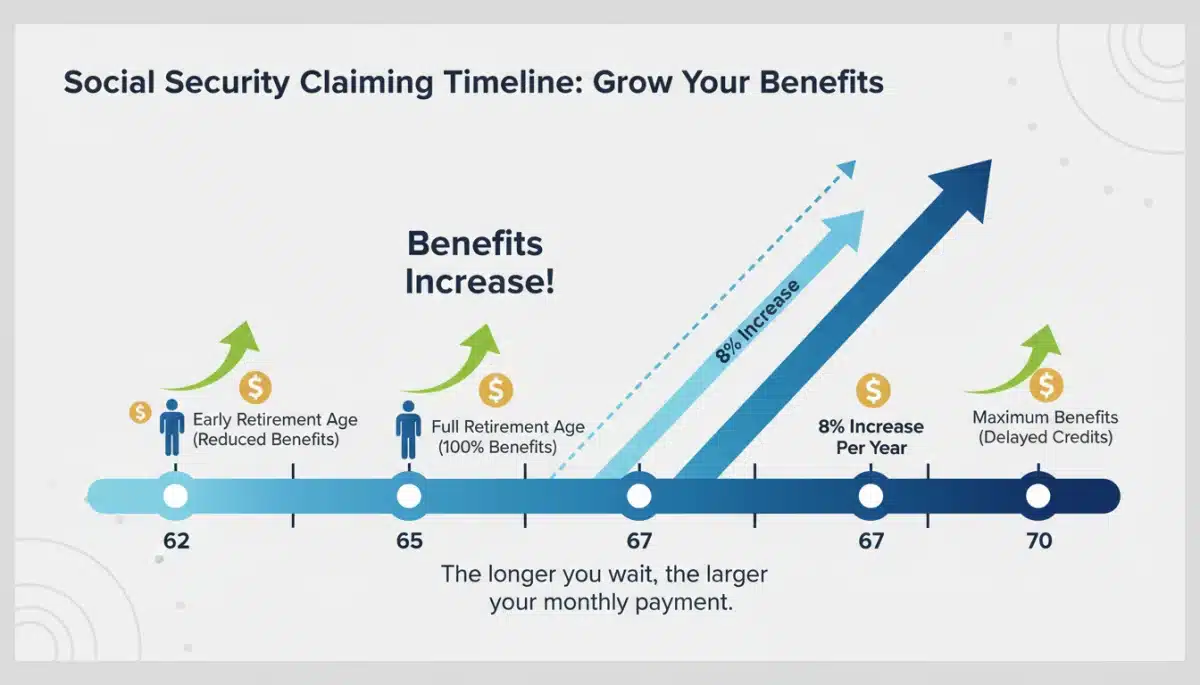
Your Full Retirement Age (FRA) is a cornerstone of Social Security planning. It’s the age at which you’re entitled to 100% of your primary insurance amount (PIA). Claiming benefits before your FRA will result in a permanent reduction, while delaying past it can lead to increased benefits. Knowing your FRA is the first critical step in making informed decisions about when to claim.
For most individuals turning 62 in 2026, their FRA will likely be 67, based on current Social Security Administration (SSA) schedules. This age is determined by your birth year, and it’s essential to confirm yours directly with the SSA to avoid any miscalculations. Understanding this specific age provides the baseline for all subsequent claiming strategies.
Advertisers
How FRA Affects Your Benefits
- Claiming Early: If you claim benefits at age 62, your monthly payment could be reduced by up to 30% permanently.
- Claiming at FRA: You receive 100% of your calculated benefit amount.
- Delaying Past FRA: For each year you delay claiming past your FRA, up to age 70, your benefits increase by a certain percentage, known as Delayed Retirement Credits (DRCs). These credits can significantly boost your monthly payment.
The decision to claim early, at FRA, or delay is highly personal and depends on various factors, including your health, other retirement savings, and life expectancy. It’s not a one-size-fits-all solution, and careful consideration of how your FRA impacts your potential payments is paramount to maximizing your overall lifetime benefits.
The Power of Delayed Retirement Credits
Delaying your Social Security claim beyond your Full Retirement Age (FRA) can be one of the most effective strategies for maximizing your monthly benefit. These increases, known as Delayed Retirement Credits (DRCs), provide a substantial boost that can significantly impact your retirement income for the rest of your life. For those with the financial flexibility to wait, this option often yields the highest monthly payout.
DRCs accumulate at a rate of 8% per year for those born in 1943 or later, up until age 70. This means that if your FRA is 67, delaying until age 70 could result in a 24% permanent increase in your monthly benefit amount. This compounding growth is a powerful incentive for many future retirees in the US to reconsider early claiming.
Calculating Your Potential Increase
- FRA 67, Claiming at 68: Your benefit is 108% of your PIA.
- FRA 67, Claiming at 69: Your benefit is 116% of your PIA.
- FRA 67, Claiming at 70: Your benefit is 124% of your PIA.
It’s important to note that benefits do not increase further after age 70. Therefore, there is no financial advantage to delaying your claim beyond that point. The decision to delay should be weighed against your current financial needs, health status, and other income sources. While the increase is attractive, it requires foregoing income for several years, which might not be feasible for everyone.
Understanding the mechanics of DRCs and how they can enhance your benefit is a key component of a comprehensive strategy for maximizing your Social Security benefits in 2026. This knowledge empowers you to make a decision that aligns with your long-term financial goals.
Navigating Spousal and Survivor Benefits
Social Security doesn’t just provide benefits based on your own earnings record; it also offers crucial spousal and survivor benefits that can significantly enhance a family’s overall retirement income. Understanding these provisions is particularly important for married couples and those who have lost a spouse, as they can unlock additional resources that might otherwise be overlooked. These benefits are designed to provide financial protection and security.
For individuals to claim spousal benefits, their spouse must generally have already filed for their own Social Security retirement benefits. The spousal benefit can be up to 50% of the working spouse’s Full Retirement Age (FRA) benefit. This can be a game-changer for couples where one spouse has a significantly lower earnings record or has not worked enough to qualify for their own benefits.
Key Considerations for Spousal Benefits
- Claiming Age: Spousal benefits can be claimed as early as age 62, but they will be reduced if claimed before the spouse’s own FRA.
- Higher Earner’s Filing: The higher-earning spouse must file for their own benefits before the lower-earning spouse can claim spousal benefits.
- Restricted Application: For those born before January 2, 1954, there was an option to file a restricted application, claiming only spousal benefits at FRA and allowing their own benefits to grow until age 70. This strategy is largely phased out for younger retirees.
Survivor benefits are equally vital, providing financial support to widows, widowers, and in some cases, dependent children. A surviving spouse can receive up to 100% of the deceased worker’s basic Social Security benefit if they claim at their own FRA. These benefits can be claimed as early as age 60 (or 50 if disabled).
Understanding the intricacies of spousal and survivor benefits is a critical part of a holistic approach to maximizing your Social Security benefits in 2026. These options provide valuable safety nets and opportunities for increased household income during retirement.
Understanding and Managing Earnings Limits
For those who plan to work while receiving Social Security benefits before their Full Retirement Age (FRA), understanding earnings limits is absolutely essential. Exceeding these limits can result in a temporary reduction of your benefits, which could undermine your efforts to maximize your overall retirement income. The Social Security Administration (SSA) sets annual thresholds that determine how much you can earn without impacting your payments.
In the year you reach your FRA, a different, higher earnings limit applies for the months before your FRA. Once you reach your FRA, earnings limits no longer apply, and you can earn as much as you want without any reduction to your Social Security benefits. This transition point is crucial for planning your work and claiming strategy.
Annual Earnings Limits (2026 Projections)
- Under FRA: The SSA will withhold $1 in benefits for every $2 you earn above the annual limit (e.g., $22,320 in 2024, subject to increase for 2026).
- In Year of FRA: The SSA will withhold $1 in benefits for every $3 you earn above a higher annual limit (e.g., $59,520 in 2024, subject to increase for 2026), but only counting earnings before the month you reach FRA.
- At or After FRA: No earnings limits apply.
It’s important to remember that any benefits withheld due to earnings limits are not permanently lost. Instead, your future monthly benefits will be recalculated at your FRA to account for the earnings that were withheld, potentially leading to a higher monthly payment later on. However, for immediate income planning, managing these limits is key.
Carefully planning your work schedule and income around these earnings limits can help you avoid unexpected reductions in your monthly payments. This strategic approach is another vital step toward maximizing your Social Security benefits in 2026 and ensuring a stable income stream during your early retirement years.
Coordinating Benefits with Your Spouse
For married couples, Social Security planning is not an individual endeavor but a joint strategy. Coordinating benefits with your spouse can significantly increase the total lifetime benefits received by both of you, often far beyond what each would receive by claiming independently. This requires understanding both spouses’ earnings records, ages, and health statuses to determine the optimal claiming sequence.
One common strategy involves the higher-earning spouse delaying their claim until age 70 to maximize their primary benefit, which then also maximizes the potential survivor benefit for the lower-earning spouse. Meanwhile, the lower-earning spouse might claim their own benefits (or spousal benefits, if applicable) earlier to provide some income during the delay period.
Strategic Coordination Points
- Higher Earner Delays: Maximizes individual benefit and potential survivor benefit.
- Lower Earner Claims First: Provides income while the higher earner’s benefit grows.
- Comparing Benefits: Always compare your own benefit to 50% of your spouse’s FRA benefit to determine if a spousal benefit would be more advantageous.
The optimal strategy will depend on various factors, including the age difference between spouses, their respective earnings histories, and their overall health. It’s often beneficial to use online Social Security calculators or consult with a financial advisor specializing in retirement planning to model different scenarios.
Effective spousal coordination is a sophisticated yet powerful method for maximizing your Social Security benefits in 2026. This joint planning approach ensures that both partners are making choices that contribute to the highest possible combined income throughout their retirement years.
Reviewing Your Social Security Statement Annually
Your Social Security Statement is a critical document that provides a personalized estimate of your future benefits based on your earnings record. Reviewing this statement annually is not just good practice; it’s an essential step in ensuring the accuracy of your earnings history and making informed decisions about your retirement planning. Any discrepancies in your earnings record can directly impact your future benefit amounts.
The Social Security Administration (SSA) makes these statements available online through a secure my Social Security account. It’s recommended to create and regularly check this account, especially as you approach retirement. This allows you to verify that all your earnings have been correctly reported, which is fundamental to calculating your Primary Insurance Amount (PIA).
What to Look For in Your Statement
- Earnings Record: Ensure all your employers and earnings are accurately listed for each year you’ve worked. Missing or incorrect entries can reduce your benefit.
- Estimated Benefits: Review the estimated benefits at different claiming ages (62, FRA, 70) to inform your claiming strategy.
- Disability and Survivor Benefits: Understand the potential benefits for you and your family in case of disability or death.
If you find any errors in your earnings record, it’s crucial to contact the SSA immediately to correct them. Providing documentation like W-2 forms or tax returns can help rectify any mistakes. Correcting these errors proactively can prevent significant reductions in your future Social Security payments.
Regularly reviewing your Social Security Statement is a simple yet powerful action. It serves as a personal audit, safeguarding your earnings record and providing the foundational data necessary for effectively maximizing your Social Security benefits in 2026 and beyond.
| Key Strategy | Brief Description |
|---|---|
| Know Your FRA | Identify your Full Retirement Age to understand benefit adjustments for early or delayed claiming. |
| Delay Claiming to 70 | Earn 8% Delayed Retirement Credits annually, up to age 70, for a significantly higher monthly payment. |
| Coordinate Spousal Benefits | Married couples can strategically claim benefits to maximize their combined lifetime income. |
| Monitor Earnings Limits | Avoid benefit reductions by understanding and managing income if working before your Full Retirement Age. |
Frequently Asked Questions About Social Security Benefits
You can start receiving Social Security retirement benefits as early as age 62. However, claiming at this age will result in a permanent reduction of your monthly benefit amount compared to what you would receive at your Full Retirement Age (FRA).
DRCs increase your monthly benefit by 8% per year for each year you delay claiming past your Full Retirement Age, up until age 70. This increase is permanent and can significantly boost your lifetime Social Security income.
Yes, you can work and receive benefits simultaneously. However, if you are under your Full Retirement Age, your benefits may be reduced if your earnings exceed certain annual limits. Once you reach your FRA, there are no earnings limits.
Spousal benefits allow an eligible spouse to receive up to 50% of their partner’s Full Retirement Age benefit. This can be particularly helpful if one spouse has a lower earnings record or hasn’t worked enough to qualify for their own benefits.
Reviewing your annual Social Security Statement ensures your earnings record is accurate, which directly impacts your future benefit calculations. Identifying and correcting errors promptly can prevent a reduction in your deserved retirement income.
Conclusion
Effectively maximizing your Social Security benefits in 2026 is a multi-faceted process that demands careful planning and a thorough understanding of the system’s rules. From pinpointing your Full Retirement Age and strategically delaying claims to leverage Delayed Retirement Credits, to wisely coordinating benefits with your spouse and diligently monitoring earnings limits, each step contributes to securing a more robust financial foundation for your retirement. Regularly reviewing your Social Security statement is also paramount to ensuring accuracy and preventing any unforeseen reductions. By taking these proactive measures, future retirees in the US can significantly enhance their Social Security income, paving the way for a more comfortable and worry-free retirement.
