Maximizing Your Social Security Benefits: 2026 Insider Strategies

Advertisers
Maximizing your Social Security benefits in 2026 requires understanding optimal claiming ages, spousal benefit rules, and potential future adjustments to secure your financial future effectively.
Advertisers
Are you approaching retirement and wondering how to get the most out of your Social Security? Understanding how to maximize your social security benefits 2026 is crucial for a secure financial future. This guide provides insider strategies for claimants to optimize their retirement income.
Advertisers
Understanding Your Full Retirement Age (FRA) for 2026
Your Full Retirement Age (FRA) is a pivotal factor in determining your Social Security benefits. For those born between 1943 and 1954, your FRA is 66. However, for individuals born in 1960 or later, including many 2026 claimants, the FRA is 67. Claiming benefits before your FRA results in a permanent reduction, while delaying beyond it can significantly increase your monthly payments.
It’s essential to pinpoint your exact FRA to make informed decisions. This age is not arbitrary; it’s set by law and directly impacts the calculation of your primary insurance amount (PIA). Understanding this benchmark is the first step towards a strategic claiming plan.
Calculating Your Full Retirement Age
- Birth Year 1943-1954: FRA is 66.
- Birth Year 1955: FRA is 66 and 2 months.
- Birth Year 1956: FRA is 66 and 4 months.
- Birth Year 1957: FRA is 66 and 6 months.
- Birth Year 1958: FRA is 66 and 8 months.
- Birth Year 1959: FRA is 66 and 10 months.
- Birth Year 1960 or later: FRA is 67.
Knowing your precise FRA allows you to project your potential benefits accurately. This foresight is invaluable when planning your retirement budget and considering various claiming scenarios. A slight delay in claiming can lead to substantial long-term gains.
Ultimately, the decision of when to claim benefits revolves around your individual circumstances, health, and financial needs. However, having a clear understanding of your FRA provides the foundation for any effective strategy to maximize your Social Security.
Strategic Claiming Ages: Early, Full, or Delayed?
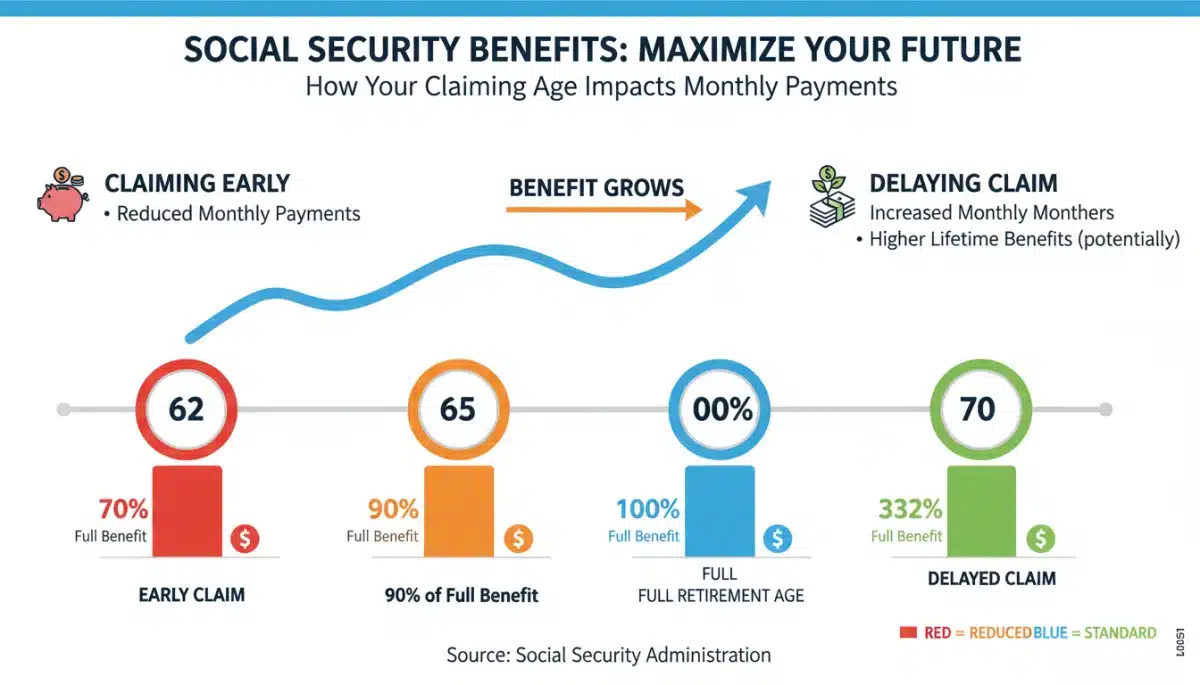
Deciding when to claim Social Security benefits is one of the most critical financial decisions you will make for retirement. You can start receiving benefits as early as age 62, at your Full Retirement Age (FRA), or delay until age 70. Each option comes with its own set of advantages and disadvantages that significantly impact your total lifetime benefits.
Claiming early at age 62 means you’ll receive benefits for a longer period, but each payment will be permanently reduced. This option might appeal to those who need income immediately or have health concerns that suggest a shorter lifespan. However, the reduction can be as much as 30% for those with an FRA of 67.
The Benefits of Delaying
Delaying benefits past your FRA, up to age 70, can lead to a substantial increase in your monthly payments. For each year you delay past your FRA, your benefits grow by approximately 8% through Delayed Retirement Credits (DRCs). This means a person with an FRA of 67 could see their monthly benefit increase by 24% if they wait until age 70 to claim.
- Age 62: Reduced benefits, but earlier access to funds.
- Full Retirement Age (FRA): Receive 100% of your primary insurance amount (PIA).
- Age 70: Maximum possible monthly benefit due to Delayed Retirement Credits.
This strategy is particularly beneficial for individuals who are in good health and have other income sources to cover their expenses until age 70. The cumulative effect of these increased payments over a long retirement can be significant, offering a strong hedge against inflation and rising living costs. It is a powerful way to maximize your social security benefits 2026.
The optimal claiming age is highly personal. It requires a careful evaluation of your health, life expectancy, current financial situation, and other retirement income sources. Consulting with a financial advisor can help you model different scenarios and determine the best approach for your specific situation.
Spousal and Survivor Benefits: Unlocking Additional Income
Social Security isn’t just for individual workers; it also provides crucial benefits for spouses and survivors. Understanding these provisions can significantly enhance your household’s overall retirement income, especially for claimants in 2026. These benefits are designed to protect families and ensure a baseline level of financial security.
Spousal benefits allow an eligible spouse to claim up to 50% of their partner’s primary insurance amount (PIA), provided their own benefit is less than this amount. This can be a game-changer for couples where one spouse has a significantly higher earning history or did not work outside the home for an extended period.
Key Considerations for Spousal Benefits
- Eligibility: Generally, you must be married for at least one year and your spouse must have filed for their own benefits.
- Claiming Age: Spousal benefits can be claimed as early as age 62, but they will be reduced. Claiming at your own FRA will yield 50% of your spouse’s PIA.
- Coordination: If you are eligible for both your own worker’s benefit and a spousal benefit, the Social Security Administration (SSA) will pay you the higher of the two amounts.
Survivor benefits are equally important, providing financial support to widows, widowers, and eligible children after a worker’s death. A surviving spouse can receive up to 100% of the deceased worker’s benefit, depending on their claiming age. This provision offers a vital safety net during a difficult time.
Strategic claiming of spousal and survivor benefits often involves coordinating decisions between partners. For instance, a higher-earning spouse might delay claiming to maximize their own benefit, which in turn increases the potential spousal or survivor benefit for their partner. This coordinated approach is a key strategy for maximizing overall social security benefits 2026 for a household.
Navigating Social Security Taxation in 2026
While Social Security benefits provide essential income, it’s crucial to understand that a portion of these benefits may be subject to federal income tax. This can often come as a surprise to new retirees and can impact their overall financial planning. The rules for taxation are based on your ‘combined income.’
Your combined income is calculated by taking your adjusted gross income (AGI), adding any tax-exempt interest (like from municipal bonds), and then adding one-half of your Social Security benefits. Depending on this total, up to 85% of your Social Security benefits could be taxable.
Combined Income Thresholds for 2026 (Projections)
- Individual Filers:
- Below $25,000: No benefits are taxed.
- Between $25,000 and $34,000: Up to 50% of benefits may be taxed.
- Above $34,000: Up to 85% of benefits may be taxed.
- Joint Filers:
- Below $32,000: No benefits are taxed.
- Between $32,000 and $44,000: Up to 50% of benefits may be taxed.
- Above $44,000: Up to 85% of benefits may be taxed.
These thresholds are not indexed for inflation, meaning that over time, more and more retirees find themselves paying taxes on their Social Security benefits as their other income sources or even their benefits themselves increase. This phenomenon is often referred to as ‘bracket creep.’
Proactive tax planning is therefore essential. Strategies might include managing withdrawals from tax-deferred accounts (like traditional IRAs and 401(k)s) to keep your combined income below certain thresholds, or utilizing Roth conversions in earlier retirement years to reduce future taxable income. Understanding and planning for the taxation of your social security benefits 2026 is vital for accurate budget forecasting.
Working While Receiving Benefits: Rules and Implications
Many individuals choose to continue working part-time or even full-time after claiming Social Security benefits. While this can provide a significant boost to retirement income, it’s crucial to understand the earnings limits set by the Social Security Administration (SSA). Exceeding these limits can lead to a temporary reduction in your benefits.
The rules vary depending on whether you are below your Full Retirement Age (FRA) or have already reached it. For those under FRA, there’s an annual earnings limit. If your earnings exceed this limit, the SSA will withhold $1 in benefits for every $2 you earn above the limit. This withholding is not permanent; the benefits are added back to your payment once you reach FRA.
Earnings Limits for 2026 (Projected)
- Below FRA for the entire year: The earnings limit is expected to be around $22,320 per year ($1,860 per month).
- In the year you reach FRA: A higher earnings limit applies, typically around $59,520 per year ($4,960 per month) for the months before you reach FRA. The SSA withholds $1 for every $3 earned above this limit.
Once you reach your FRA, the earnings limits disappear entirely. You can earn as much as you want without any reduction in your Social Security benefits. At this point, the SSA will also recalculate your benefit amount, giving you credit for any benefits that were withheld due to earlier earnings.
It’s important to keep track of your earnings if you are receiving benefits and are below your FRA. While a temporary reduction might occur, the long-term effect is often positive, as continued work adds to your earnings record, potentially increasing your future benefit amount. This flexibility allows claimants to strategically blend work income with their social security benefits 2026.
Future Outlook and Potential Changes for 2026 Claimants
The Social Security system is constantly under review, and discussions about its long-term solvency are ongoing. While significant legislative changes are not typically enacted quickly, it’s prudent for 2026 claimants to be aware of potential future adjustments that could impact their benefits. Staying informed is a key part of maximizing your financial planning.
One area frequently discussed is the Cost-of-Living Adjustment (COLA). COLAs are applied annually to Social Security benefits to help them keep pace with inflation. The COLA for 2026 will be announced in late 2025 and will reflect economic conditions at that time. While not a ‘change’ to the system, it directly affects the purchasing power of your benefits.
Potential Areas of Future Adjustment
- Full Retirement Age: While currently set at 67 for those born in 1960 or later, there have been discussions about gradually increasing the FRA further in the distant future.
- Taxation of Benefits: Proposals sometimes emerge to modify the income thresholds at which Social Security benefits become taxable.
- Benefit Formula: Less common, but not impossible, are discussions about adjusting the formula used to calculate initial benefit amounts for future retirees.
It’s important to distinguish between rumors and concrete legislative proposals. Reliable sources for information include the Social Security Administration’s official website and reports from the Congressional Budget Office (CBO). Avoid making drastic financial decisions based on speculative news.
For 2026 claimants, the immediate focus should remain on current rules and established strategies for maximizing benefits. However, maintaining an awareness of broader discussions about Social Security’s future is a responsible approach to long-term financial planning. This proactive stance ensures you are well-prepared for any potential shifts that could affect your social security benefits 2026.
Resources and Professional Guidance for Claimants
Navigating the complexities of Social Security can be daunting, especially with the various rules, claiming strategies, and potential future changes. Fortunately, a wealth of resources and professional guidance is available to help 2026 claimants make the most informed decisions about their benefits. Utilizing these resources can significantly enhance your understanding and optimize your claiming strategy.
The Social Security Administration (SSA) website is your primary official resource. It offers personalized statements, benefit calculators, and detailed publications explaining all aspects of the program. Creating an online ‘my Social Security’ account allows you to view your earnings record, estimated future benefits, and apply for benefits directly.
Where to Find Reliable Information and Support
- SSA Website: The official source for all Social Security information, including benefit calculators and application forms.
- Financial Advisors: Professionals specializing in retirement planning can provide personalized advice, modeling different claiming scenarios based on your unique financial situation.
- Non-profit Organizations: Many organizations offer free or low-cost counseling services for seniors on Social Security and Medicare.
- Educational Seminars: Attend local workshops or webinars focused on retirement planning and Social Security strategies.
Seeking professional guidance, particularly from a Certified Financial Planner (CFP) who specializes in retirement, can be invaluable. These experts can help you integrate your Social Security claiming strategy with your overall retirement plan, including investments, pensions, and other income sources. They can also provide insights into tax implications and spousal benefit coordination.
Don’t underestimate the power of knowledge and expert advice. Making an optimal decision regarding your social security benefits 2026 can have a lasting positive impact on your financial well-being throughout retirement. Invest time in research and consider professional consultation to ensure you are on the best path.
| Key Strategy | Brief Description |
|---|---|
| Know Your FRA | Understand your Full Retirement Age (FRA) to avoid benefit reductions or maximize delayed credits. |
| Delay Claiming | Consider delaying benefits until age 70 for significant monthly payment increases (8% per year past FRA). |
| Spousal Benefits | Explore claiming spousal benefits (up to 50% of partner’s PIA) to boost household income. |
| Tax Planning | Understand how combined income affects Social Security benefit taxation and plan accordingly. |
Frequently Asked Questions About 2026 Social Security Benefits
You can claim Social Security benefits as early as age 62. However, claiming at this age will result in a permanent reduction of your monthly benefit amount compared to what you would receive at your Full Retirement Age (FRA).
If you delay claiming benefits past your Full Retirement Age (FRA) up to age 70, you earn Delayed Retirement Credits (DRCs). These credits increase your monthly benefit by approximately 8% for each year you delay, significantly boosting your payout.
Yes, but if you are below your Full Retirement Age, there are annual earnings limits. Exceeding these limits can lead to a temporary reduction in your benefits, which are typically restored once you reach your FRA.
A portion of your Social Security benefits may be subject to federal income tax, depending on your ‘combined income.’ This calculation includes your adjusted gross income, tax-exempt interest, and half of your Social Security benefits.
You can create an account on the official Social Security Administration (SSA) website, ‘my Social Security.’ This online portal provides access to your earnings record and personalized benefit estimates based on your work history.
Conclusion
Successfully maximizing your social security benefits 2026 requires a blend of informed decision-making, strategic planning, and a clear understanding of the system’s intricacies. From pinpointing your Full Retirement Age to exploring spousal benefits and navigating taxation, each aspect plays a vital role in securing your financial well-being in retirement. By leveraging available resources and, when appropriate, seeking professional guidance, you can ensure that your Social Security benefits work optimally for you, providing a stable foundation for your golden years. Proactive engagement with these strategies today will yield significant returns tomorrow, making your retirement more comfortable and secure.
