Social Security Reform: Bipartisan Talks Resume for Solvency

Advertisers
Bipartisan talks have resumed to address Social Security reform, aiming to ensure the program’s long-term solvency and secure benefits beyond 2026.
Advertisers
The discussion around Social Security Reform: Bipartisan Talks Resume on Long-Term Solvency for Benefits Beyond 2026 has once again taken center stage in Washington. This vital conversation directly impacts millions of Americans, signaling a renewed push to secure the program’s future. What does this mean for current and future beneficiaries?
The urgent need for Social Security reform
Social Security, a cornerstone of American financial security for decades, faces significant challenges. The program’s long-term solvency has been a recurring concern, particularly as demographic shifts and economic factors continue to evolve. Understanding the urgency behind these bipartisan talks requires a look at the fundamental issues threatening the system.
Advertisers
The primary driver of the current crisis is the changing ratio of workers to retirees. When Social Security was established, many more workers contributed for each beneficiary. Today, that ratio has significantly narrowed, placing increased strain on the system’s ability to pay out benefits without drawing down its trust funds. This demographic shift, coupled with increased life expectancies, means that people are living longer and drawing benefits for extended periods.
Demographic shifts and financial pressures
The baby boomer generation’s entry into retirement has profoundly impacted Social Security’s finances. As this large cohort transitions from contributors to beneficiaries, the system’s expenditures are naturally rising. This trend is not new, but its effects are becoming more pronounced.
- Declining birth rates mean fewer new workers entering the workforce to support the system.
- Increased longevity allows retirees to collect benefits for more years than initially projected.
- Wage stagnation for some segments of the population limits growth in payroll tax contributions.
These factors collectively contribute to the projected shortfall in the Social Security trust funds. Without intervention, these funds are expected to be depleted, leading to a potential reduction in benefits for future generations. This looming deadline is what fuels the urgency for legislative action.
Addressing these demographic and financial pressures is paramount to ensuring that Social Security remains a reliable safety net. The bipartisan talks aim to find common ground on solutions that can stabilize the program for decades to come, balancing the needs of current retirees with the promises made to future generations.
Understanding the trust fund’s projections
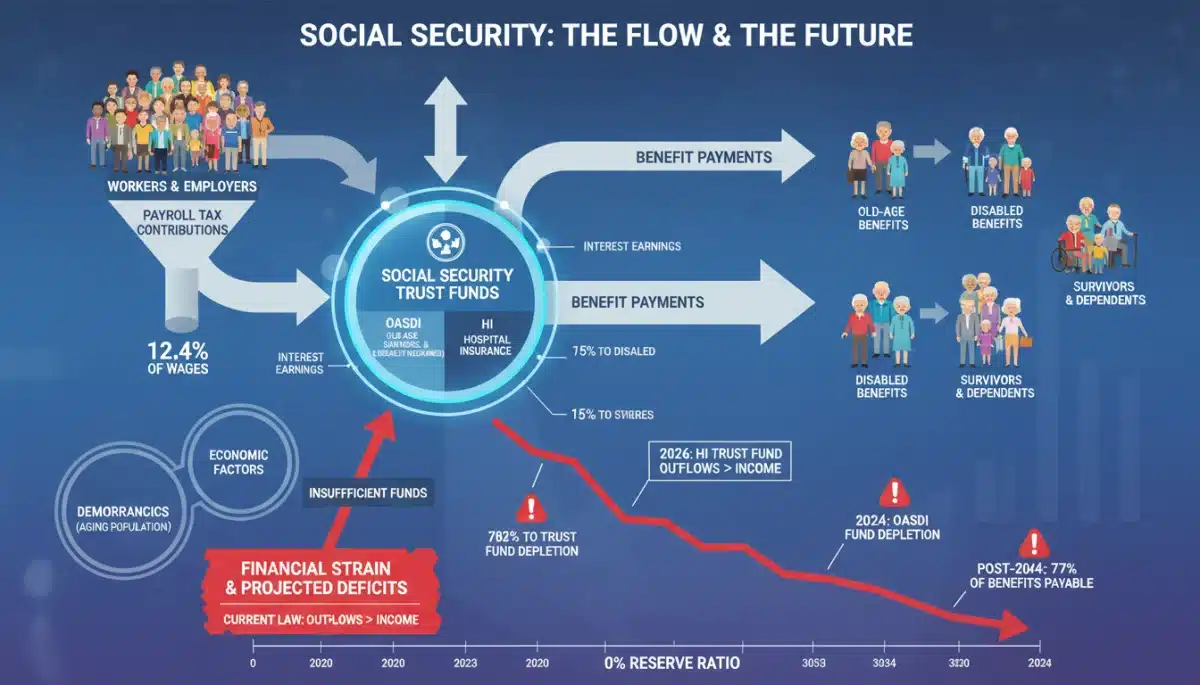
The Social Security Administration (SSA) regularly releases projections regarding the health of its trust funds. These reports are critical in informing policymakers and the public about the program’s financial outlook. Recent projections indicate that without congressional action, the combined Old-Age and Survivors Insurance (OASI) and Disability Insurance (DI) trust funds will be unable to pay 100% of promised benefits at some point in the next decade, specifically around 2033-2035, with the OASI fund facing depletion even sooner, potentially by 2033. The year 2026 is often highlighted as a crucial near-term benchmark for when the DI fund might face issues, adding to the immediate pressure for reform.
These projections are not a prediction of the program’s complete collapse, but rather an indication that the system will only be able to pay a percentage of scheduled benefits if no changes are made. For instance, if the trust funds are depleted, Social Security would still be able to pay approximately 80% of scheduled benefits through ongoing payroll tax contributions. While 80% is significant, a 20% cut would be devastating for millions of Americans who rely on these benefits for a substantial portion of their income.
Key dates and their implications
The year 2026 is a significant marker, as it is often cited in discussions around the Disability Insurance (DI) trust fund. While the larger OASI fund has a later projected depletion date than OASI, the combined funds’ solvency issues are a holistic concern. The focus beyond 2026 underscores the need for comprehensive, long-term solutions rather than temporary fixes.
The annual Trustees’ Report provides detailed actuarial analyses, including various scenarios based on different economic and demographic assumptions. These reports consistently point to a growing imbalance between incoming revenues and outgoing expenditures. The gap is primarily due to the aging population and lower birth rates, which reduce the worker-to-beneficiary ratio.
- The OASI Trust Fund is projected to be depleted by 2033, impacting retired workers and their survivors.
- The DI Trust Fund is projected to be able to pay full benefits until 2057, but the combined funds are the primary concern.
- Combined trust funds are projected to be depleted by 2033, after which 80% of scheduled benefits would be payable.
Understanding these projections is vital for stakeholders. They illustrate that the problem is not hypothetical but a quantifiable challenge requiring immediate and sustained attention. The bipartisan talks are a direct response to these findings, aiming to proactively address the shortfall before it becomes an unavoidable crisis.
The implications of inaction are severe, ranging from reduced benefits for future retirees to a potential loss of confidence in the program itself. Therefore, the ongoing discussions are not just about numbers; they are about preserving the financial security and trust of an entire nation.
Historical context of Social Security reform efforts
Discussions about Social Security reform are not new; they have been a recurring theme in American political discourse for decades. The program has undergone significant changes since its inception in 1935, adapting to evolving economic realities and societal needs. Examining past reform efforts provides valuable context for the current bipartisan talks.
One of the most notable reforms occurred in 1983, when a bipartisan commission led by Alan Greenspan recommended a package of changes to address a looming shortfall. These reforms included a gradual increase in the full retirement age, an increase in the payroll tax rate, and the taxation of Social Security benefits for higher-income earners. These adjustments successfully stabilized the program for several decades, demonstrating the effectiveness of bipartisan cooperation.
Past successes and challenges
The 1983 reforms serve as a powerful precedent for what can be achieved when political leaders set aside partisan differences for the greater good. However, subsequent attempts at reform have often stalled due to political gridlock and the inherent difficulty of making changes to a program that touches nearly every American family.
- The 1983 amendments extended solvency for decades through a combination of tax increases and benefit adjustments.
- Later reform attempts, particularly in the early 2000s, failed to gain traction amidst strong political opposition.
- The current challenge is similar to previous ones, but with different demographic and economic landscapes.
The primary challenge in any reform effort is balancing the diverse interests of various stakeholders: current retirees, near-retirees, younger workers, and those with disabilities. Any proposed changes inevitably involve trade-offs, making consensus building a complex and often contentious process. This is why bipartisan engagement is so crucial; it’s the only path forward that has historically yielded results.
The historical context underscores that while the challenges are significant, they are not insurmountable. Past reforms demonstrate that with political will and a commitment to compromise, solutions can be found to ensure Social Security’s enduring strength. The current bipartisan talks draw upon this legacy, seeking to forge a new path forward for the program.
Key proposals on the table for discussion
The current bipartisan talks are exploring a range of proposals aimed at shoring up Social Security’s finances. These ideas generally fall into two broad categories: increasing revenue and adjusting benefits. Each approach has its proponents and detractors, reflecting the complex trade-offs involved in reforming such a vital program.
Increasing revenue typically involves adjustments to the payroll tax, which is the primary funding source for Social Security. This could mean raising the tax rate itself or increasing the amount of income subject to the tax. Currently, there’s a cap on earnings subject to Social Security taxes, meaning high-income earners do not pay taxes on all their income. Raising or eliminating this cap is a frequently discussed option.
Revenue-side solutions
Several revenue-focused proposals are being considered to address the shortfall. These aim to bring more money into the system without directly cutting benefits for current or future retirees. The impacts of these proposals vary depending on income levels and economic circumstances.
- Raising the payroll tax rate: A modest increase in the percentage of earnings contributed by workers and employers.
- Increasing the taxable earnings cap: Applying Social Security taxes to a greater portion of high earners’ income, or even eliminating the cap entirely.
- Diversifying funding sources: Exploring options beyond payroll taxes, though this is often more controversial.
On the other hand, benefit adjustments involve changes to how much beneficiaries receive or when they receive it. These can include raising the full retirement age, altering the cost-of-living adjustment (COLA) formula, or modifying the benefit calculation for future retirees. These changes often face greater public resistance due to their direct impact on individuals’ financial planning.
Benefit-side adjustments
Proposals to adjust benefits aim to reduce the program’s expenditures, thereby extending the solvency of the trust funds. These are often politically sensitive but are considered necessary by some to achieve long-term stability.
- Raising the full retirement age: Gradually increasing the age at which individuals can claim full benefits, reflecting increased life expectancies.
- Modifying the COLA formula: Adjusting how annual cost-of-living increases are calculated, potentially leading to slightly smaller annual increases.
- Changing the benefit formula: Altering the formula used to calculate initial benefits for future retirees, often impacting higher earners more significantly.
The challenge for lawmakers is to find a politically viable combination of these revenue and benefit adjustments that can garner bipartisan support. The goal is to create a sustainable system that continues to provide essential benefits while minimizing adverse impacts on beneficiaries and contributors. The ongoing discussions are crucial for evaluating the feasibility and equity of each proposed solution.
Impact on current and future beneficiaries
Any reform to Social Security inevitably raises questions about its impact on beneficiaries, both those currently receiving payments and those who will in the future. The goal of the bipartisan talks is to ensure the program’s long-term viability without unduly burdening any single group. However, different proposals will have distinct effects on various cohorts.
For current retirees, changes are often designed to be minimal or non-existent, as they have already made their financial plans based on existing rules. However, even small adjustments to cost-of-living increases or taxation of benefits could have an impact. The political reality is that any significant cuts to current benefits would likely face massive public opposition.
How reforms could affect different age groups
Future retirees, particularly younger generations, are more likely to experience the effects of reform. This could include a higher full retirement age, a modified benefit formula, or increased payroll taxes throughout their working lives. While these changes might seem distant, they require careful consideration for long-term financial planning.
- Current retirees: Likely minimal impact on direct benefit amounts, but potential adjustments to COLA or taxation.
- Near-retirees (next 5-10 years): Could face a slightly higher full retirement age or minor adjustments to benefit calculations.
- Younger workers: Most likely to see increases in payroll taxes, a higher full retirement age, and potentially a revised benefit formula.
Disability beneficiaries also factor into these discussions. While the DI trust fund has a later projected depletion date than OASI, its solvency is still intertwined with the overall health of the Social Security system. Reforms must consider the unique needs of those who rely on disability benefits.
The balancing act in these reforms is delicate. Policymakers must weigh the need for fiscal sustainability against the social contract that Social Security represents. The discussions aim to craft solutions that are equitable across generations and income levels, preserving the program’s core mission while adapting it to 21st-century realities. Understanding these potential impacts is crucial for all Americans as the reform process unfolds.
The path forward: consensus and compromise
Achieving meaningful Social Security reform hinges on the ability of lawmakers to find common ground and forge a bipartisan consensus. The history of successful reforms demonstrates that compromise is not only possible but essential when addressing such a complex and politically charged issue. The current talks represent a renewed opportunity to bridge divides and secure the program’s future.
The political landscape is often characterized by deeply entrenched positions, making compromise challenging. However, the impending insolvency of the Social Security trust funds provides a powerful incentive for both parties to work together. The alternative – a significant, automatic cut in benefits – is unpalatable to nearly everyone.
Building bridges across political divides
Successful bipartisan negotiations typically involve a willingness from all sides to move away from maximalist positions. This means acknowledging the legitimate concerns of the opposing party and seeking solutions that incorporate elements from various proposals. The goal is not to declare a winner, but to find a collective solution that benefits the nation.
- Open dialogue: A commitment to honest and transparent discussions about the challenges and potential solutions.
- Shared data: Relying on objective actuarial data and projections from the Social Security Administration.
- Flexibility: A willingness to consider a range of options, including both revenue increases and benefit adjustments.
The role of leadership is paramount in these discussions. It requires individuals who are willing to take political risks and advocate for solutions that may not be universally popular within their own party. The long-term health of Social Security transcends short-term political gains.
The path forward for Social Security reform is undoubtedly challenging, but the resumption of bipartisan talks offers a glimmer of hope. By focusing on shared goals and embracing the spirit of compromise, lawmakers have the opportunity to enact reforms that will safeguard this vital program for generations to come. The stakes are high, but so is the potential reward of securing America’s financial future.
What happens if no action is taken?
The question of what happens if Congress fails to act on Social Security reform is a critical one, and the answer carries significant implications for millions of Americans. Without legislative intervention, the Social Security trust funds are projected to become depleted, leading to an automatic reduction in benefits. This is not a hypothetical scenario but a statutory consequence of inaction, based on current law.
Specifically, if the combined OASI and DI trust funds are depleted, Social Security would only be able to pay out benefits based on incoming payroll taxes. The latest projections indicate that, at that point, the system would be able to pay approximately 80% of scheduled benefits. While 80% sounds substantial, a 20% cut would represent a significant blow to the financial security of retirees, individuals with disabilities, and survivors who rely on these payments.
The consequences of inaction
The effects of a 20% benefit cut would ripple through the economy, impacting individuals and families across the country. Many retirees depend on Social Security for a substantial portion of their income, and a reduction could force difficult choices regarding housing, healthcare, and daily expenses. This would not only increase financial hardship but also potentially lead to a rise in poverty rates among seniors.
- Benefit cuts: An immediate and automatic reduction of approximately 20% for all beneficiaries.
- Economic instability: Reduced consumer spending and increased financial strain on vulnerable populations.
- Loss of confidence: Erosion of public trust in the government’s ability to manage essential programs.
Moreover, the uncertainty surrounding Social Security’s future could have broader economic consequences. Individuals planning for retirement might delay their plans or take on additional financial risks, impacting labor markets and investment decisions. The program’s stability is not just a matter of individual benefits; it’s a matter of national economic confidence.
The resumption of bipartisan talks underscores the gravity of this situation. Lawmakers understand that inaction is not a neutral choice; it is a decision with profound and adverse consequences. The pressure to find a solution before the trust funds are depleted is immense, driving the urgency behind the current reform efforts. The goal is to avoid the scenario of automatic cuts and instead implement thoughtful, deliberate changes that ensure the program’s long-term health.
| Key Aspect | Brief Description |
|---|---|
| Solvency Challenge | Social Security trust funds projected to be depleted by 2033, leading to ~20% benefit cuts without action. |
| Bipartisan Talks | Lawmakers have resumed discussions to find a consensus on long-term solutions. |
| Proposed Solutions | Include raising payroll taxes, adjusting the earnings cap, and modifying benefit formulas or retirement age. |
| Impact on Beneficiaries | Reforms aim to minimize impact on current retirees while potentially affecting future generations. |
Frequently asked questions about Social Security reform
Reform is urgent because the Social Security trust funds are projected to be depleted by 2033. Without changes, the program will only be able to pay about 80% of scheduled benefits, which would significantly impact millions of Americans relying on these payments for their financial security.
Long-term solvency refers to Social Security’s ability to meet its financial obligations far into the future. The program faces a shortfall because demographic shifts, like increased life expectancy and lower birth rates, mean fewer workers are contributing relative to the number of beneficiaries.
Proposals include increasing the payroll tax rate, raising or eliminating the cap on taxable earnings, gradually increasing the full retirement age, and modifying the cost-of-living adjustment (COLA) formula. Lawmakers are discussing a combination of these options.
The impact varies by age. Current retirees might see minimal changes, possibly to COLA. Near-retirees might face a slightly higher full retirement age. Younger workers could experience increased payroll taxes and a higher retirement age, or a revised benefit formula.
If no legislative action is taken, Social Security benefits would automatically be cut by approximately 20% once the trust funds are depleted around 2033. The program would then only be able to pay benefits based on ongoing payroll tax revenues.
Conclusion
The resumption of bipartisan talks on Social Security reform marks a critical juncture for the financial future of millions of Americans. The challenges are real, driven by demographic shifts and economic realities that threaten the program’s long-term solvency beyond 2026. While the path to consensus is fraught with political complexities, the historical success of bipartisan efforts offers a blueprint for overcoming these hurdles. The urgency of the situation demands that lawmakers find common ground on a balanced set of solutions, combining revenue enhancements and thoughtful benefit adjustments. The goal is to safeguard Social Security, ensuring it remains a bedrock of financial security for current and future generations, thereby averting the severe consequences of inaction.
